

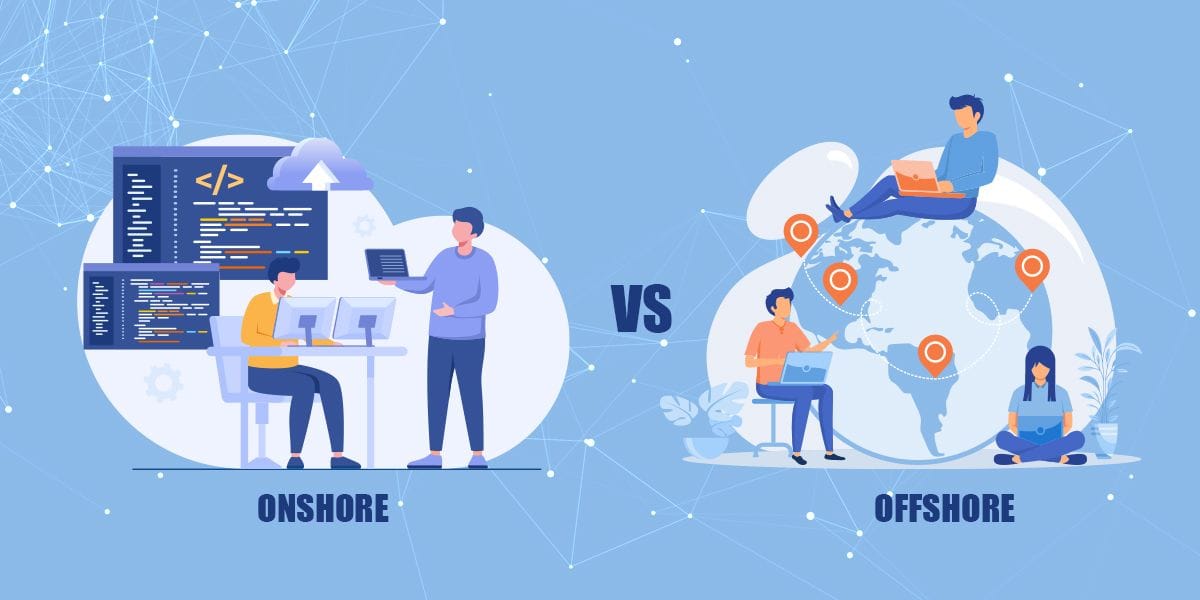
Are you looking for solution to save money, time, and resources to help your business grow? To avoid wasting money, time, and resources, outsourcing is the best solution for this. When it comes to outsourcing, there is a big question often comes up, should you go onshore outsourcing or offshore outsourcing. Because both has a lot of advantages for business. In this blog will cover what is onshore, offshore, and the differences between offshore and onshore outsourcing.
In this blog, we will explain what onshore and offshore outsourcing are, along with their benefits, challenges, and key differences to help you make the right decision.
What is Onshore Outsourcing, Its Benefits and Challenges?
Onshore outsourcing refers to hiring a company or a development team within your own country to handle specific tasks, services, or business operations that could otherwise be done in-house. It is also known as domestic outsourcing and is commonly used for software development, customer support, and marketing services.
Benefits of Onshore Outsourcing:
- Easier communication and faster turnaround time
- Fewer misunderstandings in language and work style
- Both parties operate under the same legal system
- Face-to-face meetings are possible when needed
Challenges of Onshore Outsourcing:
- Higher costs
- Limited workforce availability
- High demand for local professionals
- Standard market rates are expensive
What is Offshore Outsourcing, Its Benefits and Challenges?
Offshore outsourcing refers to hiring a company or team from another country to handle assigned tasks, services, or business operations instead of managing them in-house. It is widely used for software development, web development, customer support, data entry, IT services, and digital marketing.
Benefits of Offshore Outsourcing:
- Cost-effective solution
- Access to skilled professionals worldwide
- 24/7 work cycle due to different time zones
Challenges of Offshore Outsourcing:
- Communication delays
- Cultural differences
- Quality control challenges
Key Differences Between Onshore and Offshore Outsourcing
Outsourcing comes in different forms, but the most common types are onshore and offshore outsourcing. Below are the key differences to help you understand which option suits your business better.
Cost Efficiency
One of the major differences is cost. Onshore outsourcing typically involves higher labor costs due to local salaries, taxes, and living standards. In contrast, offshore outsourcing is more budget-friendly, as countries like India, the Philippines, and Eastern Europe offer skilled professionals at lower costs compared to regions such as the US, UK, and Australia.
Working Hours Gap
Time zones play a significant role in communication and workflow. Onshore outsourcing allows teams to work within the same time zone, making communication faster and more efficient. Offshore outsourcing, however, may involve large time differences, which can lead to delays in communication and updates.
Language Differences and Communication Gaps
Language can be a challenge in offshore outsourcing. Differences in language, accents, and communication styles may lead to misunderstandings. In onshore outsourcing, communication is generally smoother as both parties share the same language and cultural context.
Business Culture Differences
Onshore teams usually share similar work cultures, holidays, and communication styles, making collaboration easier. Offshore teams may have different cultural practices, holidays, and time zones, which can impact project timelines and communication.
Resources and Security
Data security is a major concern for businesses. Onshore outsourcing provides better control over resources and ensures compliance with local laws. Offshore outsourcing may involve additional challenges related to data security and regulations, as different countries have different legal standards.
Which One Should You Choose?
Choosing between onshore and offshore outsourcing depends on your business needs. If you require better control, easy communication, and high data security, onshore outsourcing is the right choice. If your goal is to reduce costs and access a global talent pool, offshore outsourcing is a better option.
In simple terms, onshore outsourcing is best for control and security, while offshore outsourcing is ideal for cost savings and scalability.
Conclusion
Understanding the differences between onshore and offshore outsourcing helps you make informed business decisions. Onshore outsourcing offers better communication, control, and security, while offshore outsourcing provides cost efficiency and access to global talent.
Your decision should be based on your priorities—whether it is cost, control, security, or scalability.
Need help choosing the right model? At Authorselvi, we offer both onshore and offshore outsourcing services tailored to your business goals.
For more details, contact us at info@authorselvi.com.